All Categories
Featured

Key Business Growth Roadmaps for the Americas Markets
Table of Contents
Nearshore sales groups are typically a great fit for businesses that need real-time outreach and strong discussion quality. Groups in locations like Paraguay or Belize can adapt their tone to local markets and construct trust more naturally in live calls. This design supports higher engagement and smoother handoffs, specifically for sales cycles that count on relationship-building.
Offshore sales groups are a strong alternative for business aiming to scale outreach quickly and cost-effectively. List building outsourcing locations like Tunisia and Georgia offer skilled teams that can handle lead research, cold calling, and outbound prospecting with clear procedures and consistent output. This design is specifically effective for creating interest at the top of the funnel.
Data and analytics contracting out is when companies bring in outdoors groups to help turn raw information into beneficial insights. This assistance permits internal groups to focus on strategy while external partners handle the analysis needed to guide daily decisions. Nearshore analytics groups frequently work closely with customers to support reporting and forecasting.
Detailed Report On Remote Talent Hub Trends
This makes it much easier to adjust dashboards or present findings without long delays. While team sizes may be smaller sized, the close coordination assists companies remain aligned as requirements develop. Offshore analytics groups are appropriate for large-scale data processing and high-volume back-office jobs.
For projects that need less back-and-forth, offshore outsourcing can provide speed and scale without overwhelming internal resources. Choosing the right outsourcing model depends on what your organization needs most today. Some teams focus on speed and real-time interaction, while others concentrate on cost savings or tapping into specialized abilities. Your internal capacity and job scope all contribute.
Time zone positioning makes it easier to meet to review work and change quickly., opt for offshore. It's the most cost-efficient option when your group can manage postponed feedback or structured updates., stick with onshore. Working with a U.S.-based team makes coordination much easier, especially for delicate or high-touch projects., contracting out offshore or nearshore can assist cover execution without growing headcount., offshore can scale rapidly with a large skill pool and predictable costs., nearshore might be much better.
Select nearshore for faster iterations, offshore for structured, high-volume builds. Picking the right outsourcing model is just the initial step. To get real outcomes, you require a trustworthy contracting out partner who comprehends your top priorities, from budget and time zones to security and interaction. A strong partner can assist protect your copyright, lower danger, and make sure your team is supported by the right individuals in the best places.
Whether you're a startup releasing fast or an established company all set to scale, we assist you assess possible partners and make a positive decision on a partner you can rely on. Our customers rely on us to suggest contracting out business that consistently satisfy expectations.
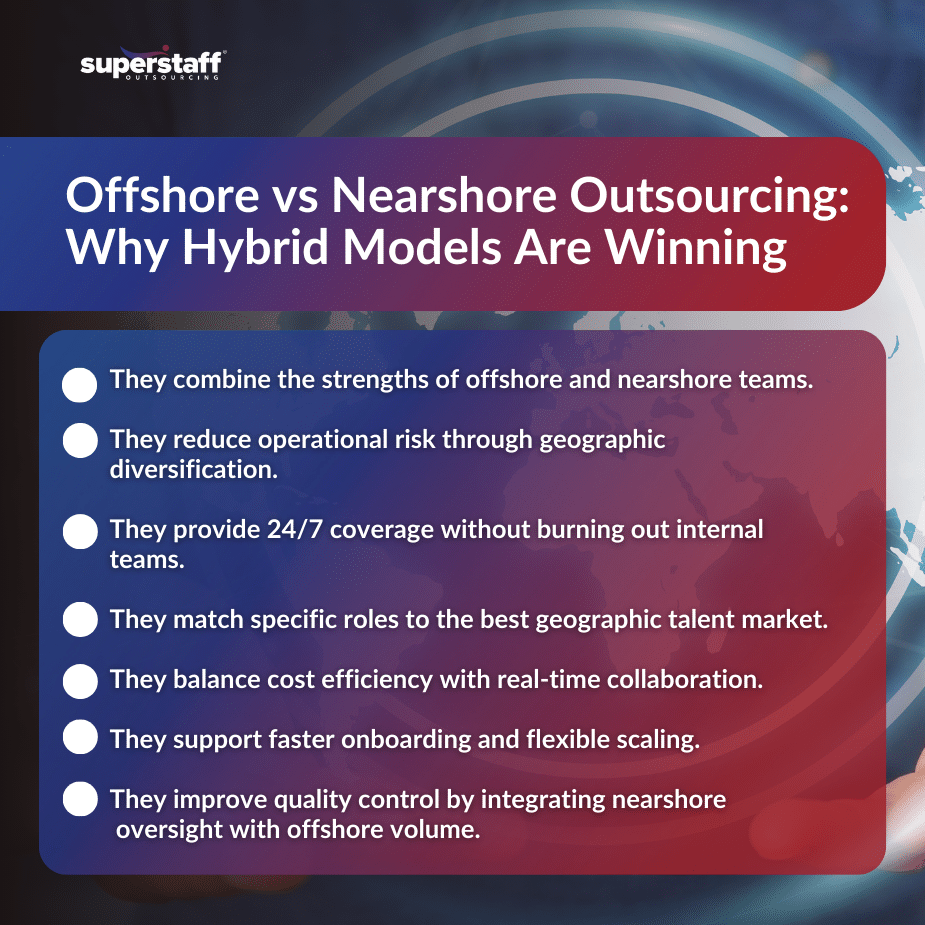
Comparing Nearshore and Hybrid Models for 2026
As businesses continue to expand and globalize, the need for cost-effective and efficient development models has actually ended up being significantly essential. Three popular advancement models that business typically think about are nearshoring, offshoring, and onshoring. In this post, we will explore the distinctions in between these designs and assist you choose which one is best for your business.
This cooperation service design was the very first one which appeared on the development market when the technologies occur. This is normally done to preserve higher control over the advancement process, lower threats associated with communication and cultural differences, and support local organizations and communities.
It was the main approach of production for a lot of items in the nation till the mid-20th century. The development of globalization and the rise of offshoring and nearshoring caused a decrease in onshoring in the latter half of the 20th century. Business began to move their manufacturing and production to countries with labour cost reduction and fewer regulations, to increase earnings and have a competitive advantage.
Launch Effective Nearshore Operations for Minimize Overhead
Numerous business started to recognize the advantages of onshoring, such as much shorter supply chains, better interaction and collaboration, and more control over the quality and consistency of their products in their own country. In the last few years, onshoring has ended up being progressively popular as business have faced challenges in offshoring and nearshoring, such as increasing labour costs, supply chain disruptions, and geopolitical instability.
Short Nearshoring HistoryThe history of nearshoring can be traced back to the early 1990s, when the North American Free Trade Arrangement (NAFTA) was signed between the United States, Canada, and Mexico. This arrangement developed an open market zone between the 3 nations, that made it easier for companies to contract out work to Mexico.
Companies in Western Europe began contracting out work to countries in Eastern Europe, such as Poland, Romania, and Ukraine, which provided lower expenses and a highly experienced workforce without language barriers and a perfect geographical place. Today, nearshoring is a popular alternative to offshoring, as it permits companies to take advantage of lower labour costs while maintaining closer cultural and linguistic ties to their home nation.
Some popular nearshoring locations consist of Mexico, Canada, Eastern Europe, and South America. Offshoring is a service model where a company outsources work to a foreign nation, typically to take benefit of lower labour costs, access to specialized abilities, and other elements such as favourable tax policies or regulatory environments. The goal is to achieve expense savings while increasing effectiveness and efficiency.
manufacturing business started outsourcing work to Japan, which was becoming a substantial commercial power at the time. This trend continued into the 1970s and 1980s, as U.S. companies started contracting out work to other countries in Asia, such as Taiwan, South Korea, and China. In the 1990s and 2000s, offshoring became a lot more popular, as the internet and advances in interaction innovation made it easier for companies to outsource work to nations worldwide.
Detailed Report of Global Talent Hub Trends
Today, offshoring remains a popular option for companies in many markets, such as manufacturing, software development, and consumer service. It enables business to gain access to lower labour expenses and specialized skills, while also offering opportunities for economic development in establishing countries. Some popular offshoring destinations include India, China, the Philippines, and Western Europe.
Onshore, nearshore, and offshore are three different organization models for contracting out work to external partners. They vary based upon the geography of the partner, ease and speed of partnership, cost, and infrastructure. Here are the essential differences: Onshore outsourcing involves partnering service procedures with a business in the very same country or nearby town as the client business.

Latest Posts

Talent Management Trends to Watch for 2026

Strategic Expansion Tactics for Multinational Scale

Global Labor Law Updates: Key Changes